Original Art · Authenticity Certificate · Secure Delivery Across India
30 Artworks
Mayuri
Framing available
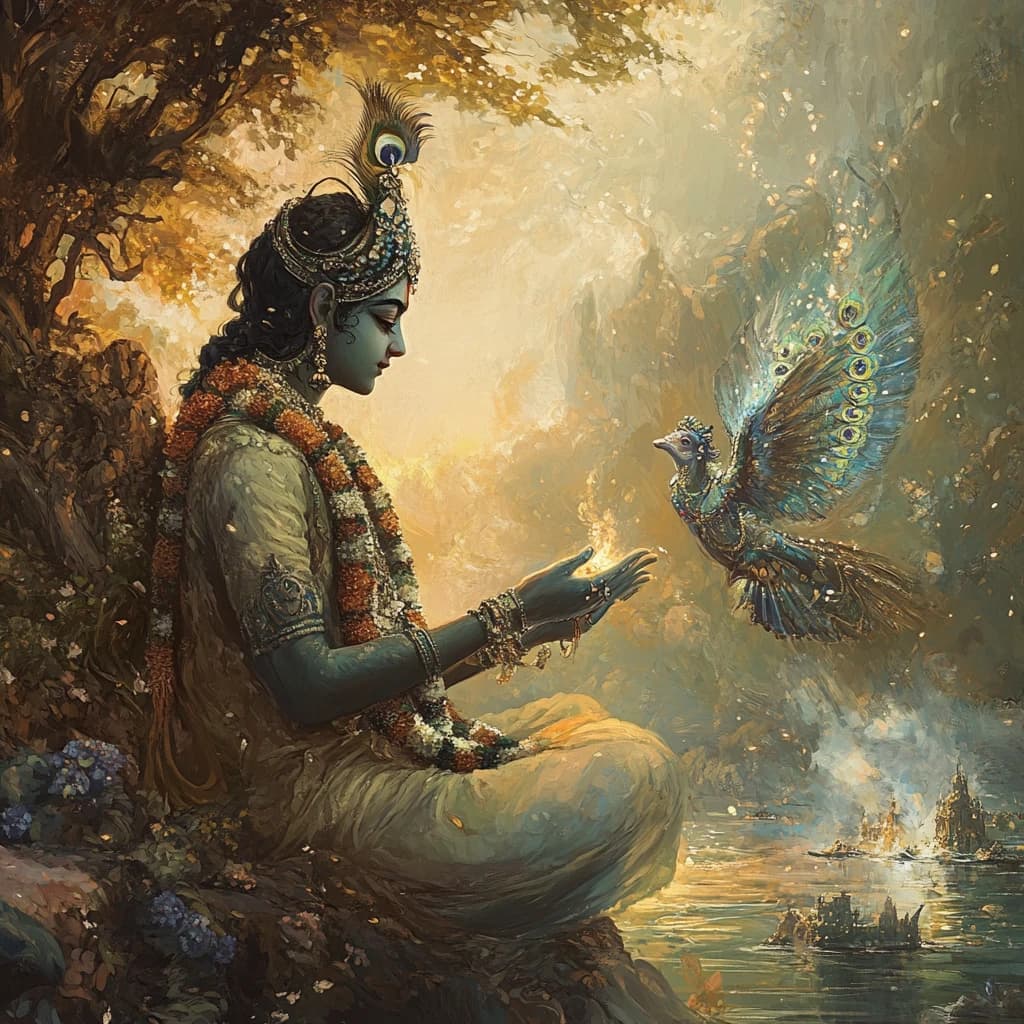
Govinda and the Peacock places a single peacock beside Krishna, its plumage in quiet dialogue with the feather worn i...
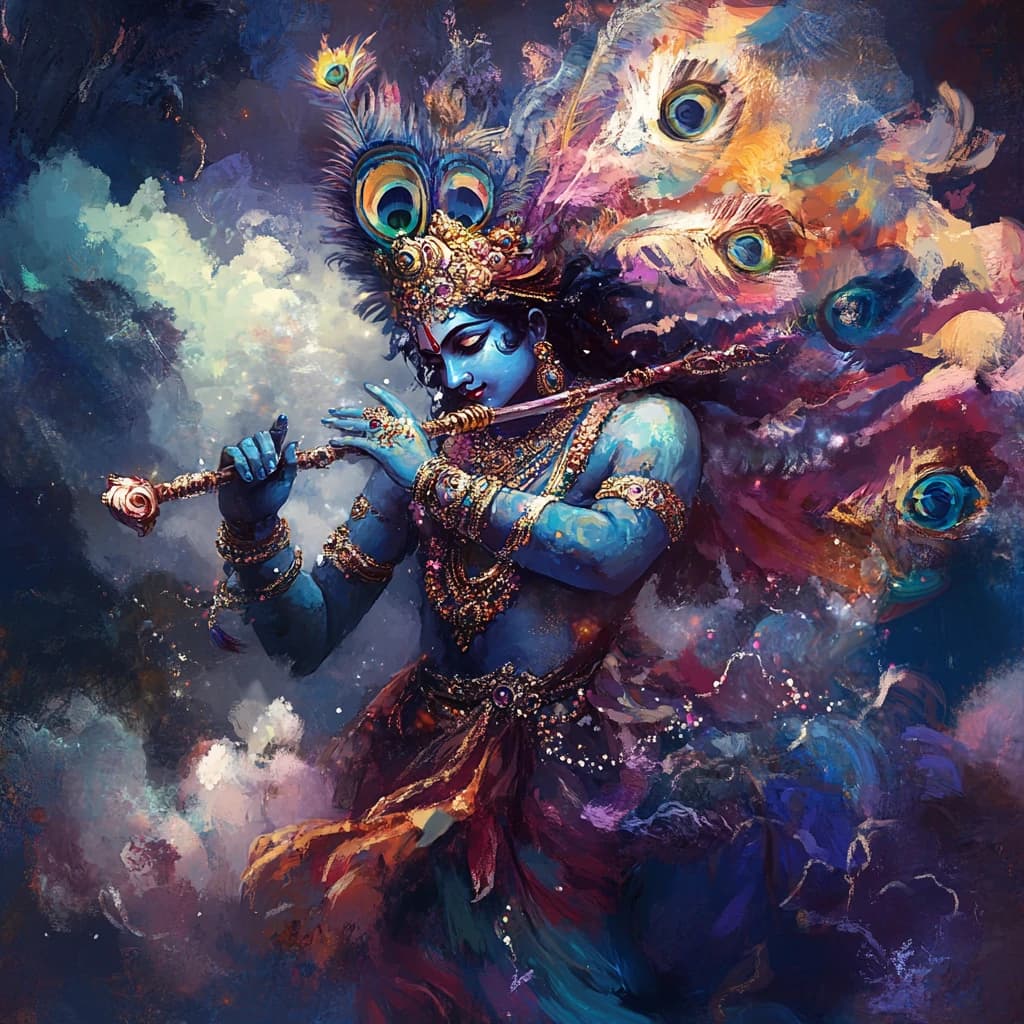
Govinda's Melody surrounds a flute-playing Krishna with peacocks, their feathers echoing the peacock plume traditiona...
Krishna leans into his flute in the last blue light of evening, a single peacock feather catching what remains of the sun. The palette holds to deep indigo and slate, with gold used sparingly at the jewellery and the rim of the horn — restraint that makes the piece read as devotional rather than decorative. Suits a living room wall that already has warm wood or brass to answer the gold.
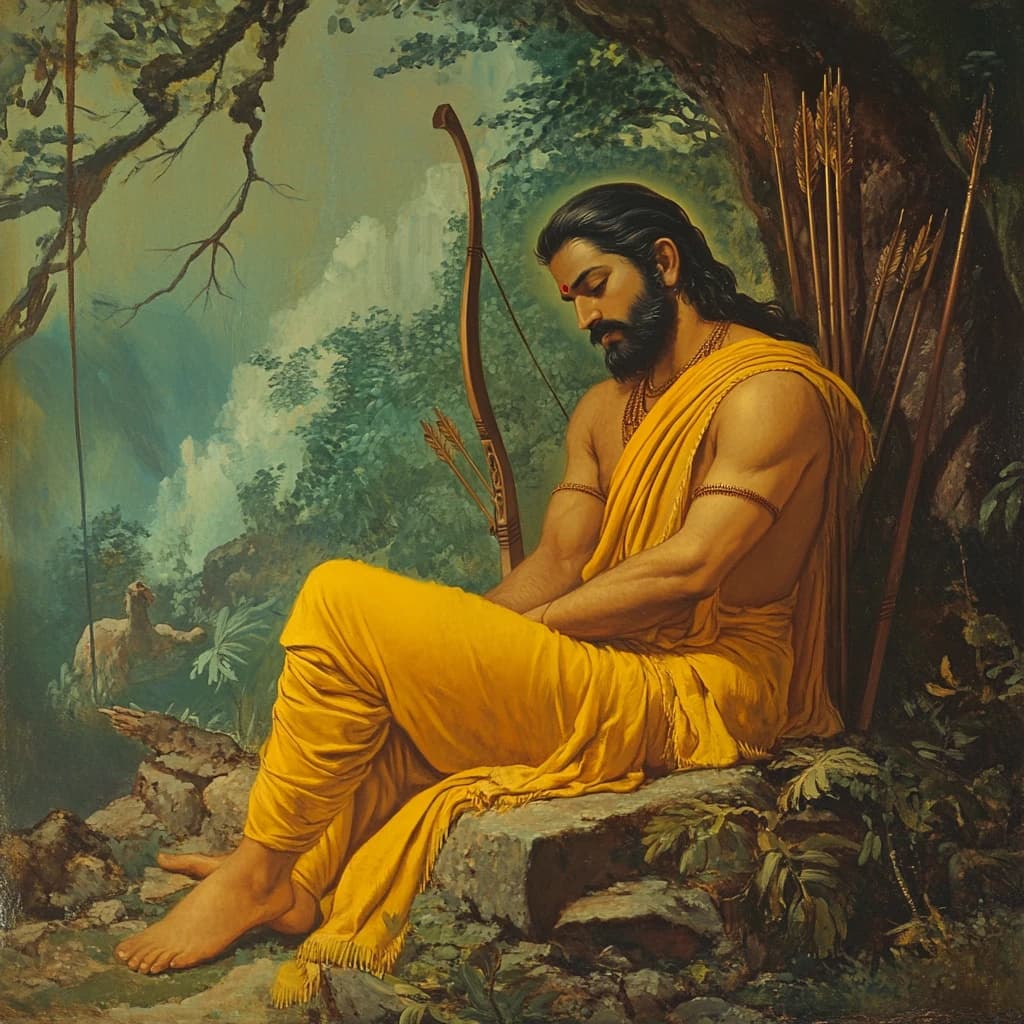
Rama at rest rather than at war — bow set aside against the rock, the forest closing in green and gold behind him. The saffron of the robe is the only high-chroma note in the composition, which is what gives the figure its stillness. A quiet, upright piece for an entryway or a study, where a single strong vertical is worth more than a busy wall.
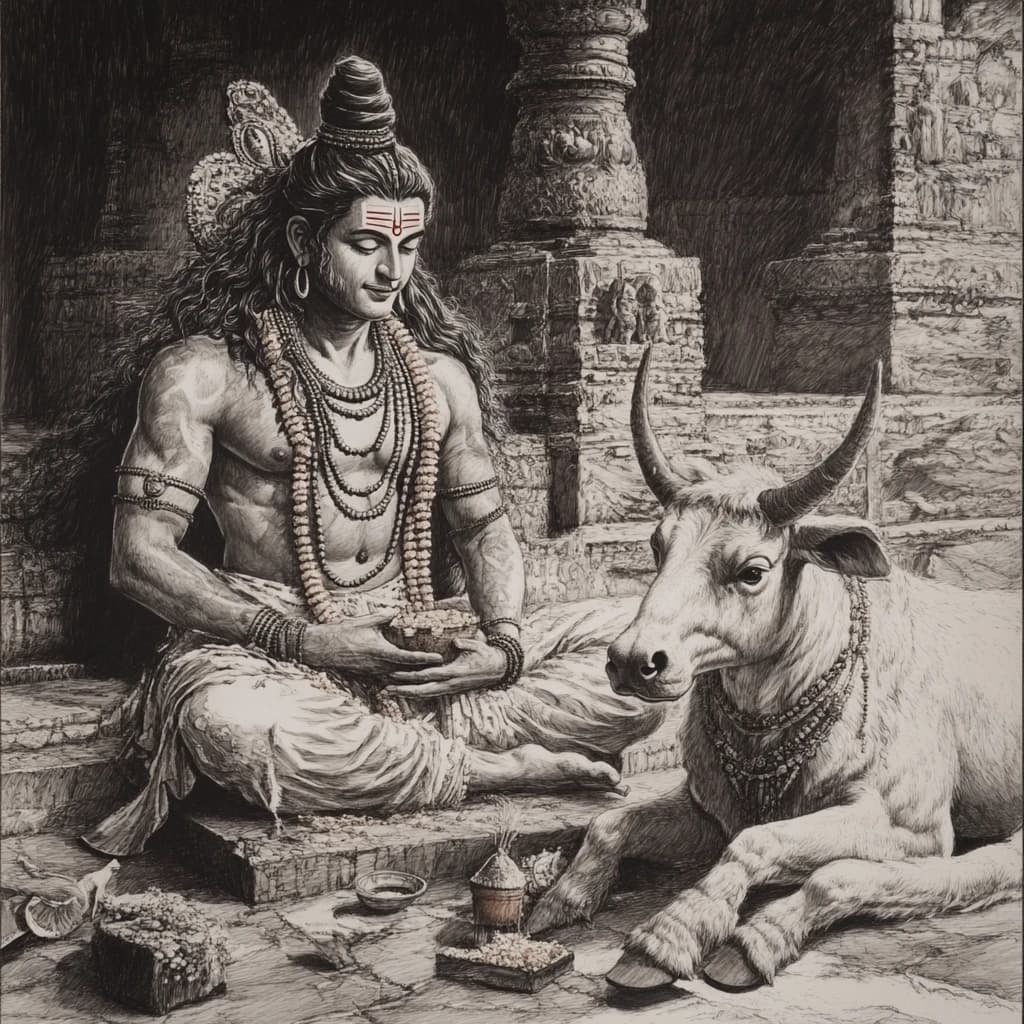
A monochrome study of Shiva with Nandi, worked entirely in graphite tones against carved temple stone. Stripping the colour out pushes everything onto line and weight — the fall of the bull's shoulder, the tension in the seated figure. Reads as drawing rather than painting, which makes it an easy piece to live with in a room that is already colourful.
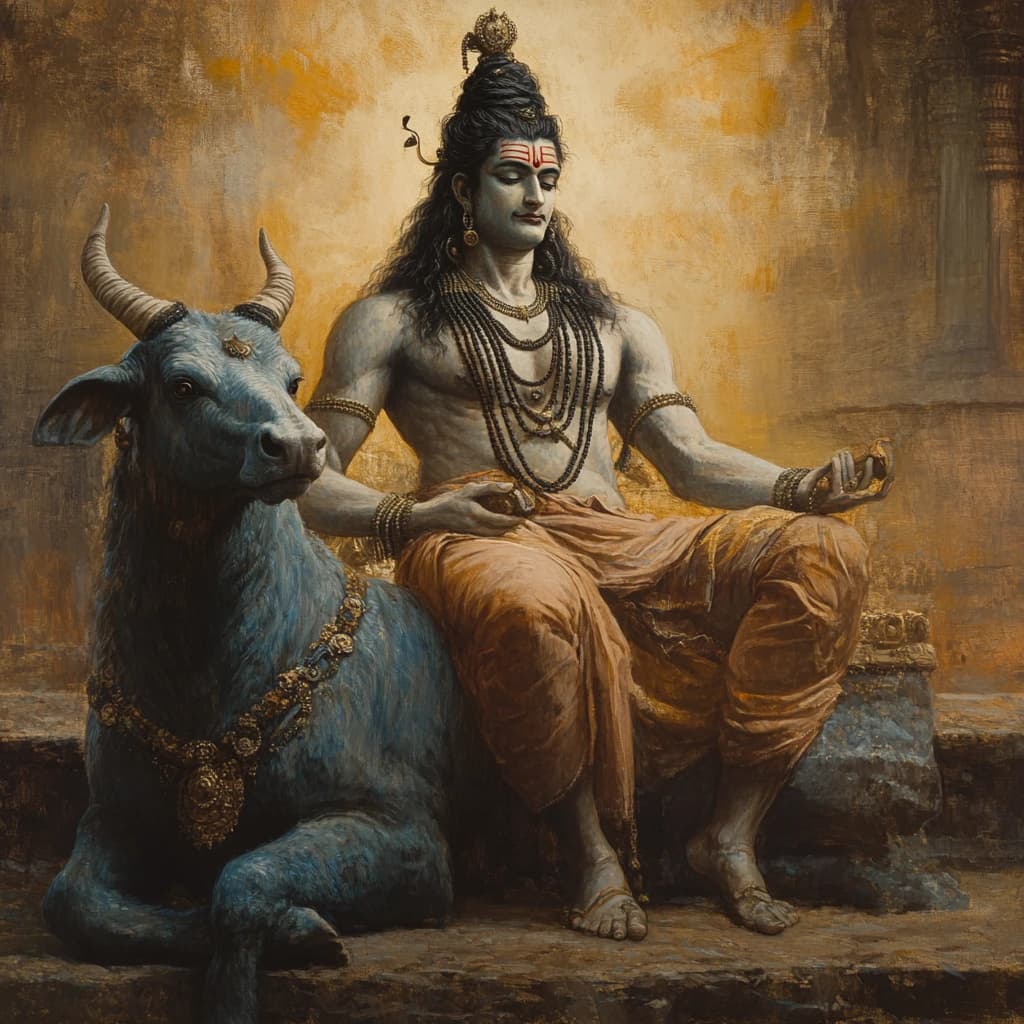
Shiva and Nandi against a wash of burnt ochre, the whole canvas held in a narrow band of earth tones — rust, clay, muted saffron. There is almost no cool colour anywhere in it, which is unusual for the subject and gives the piece an enveloping warmth. Best on a pale wall, where the ochre can do its work without competition.
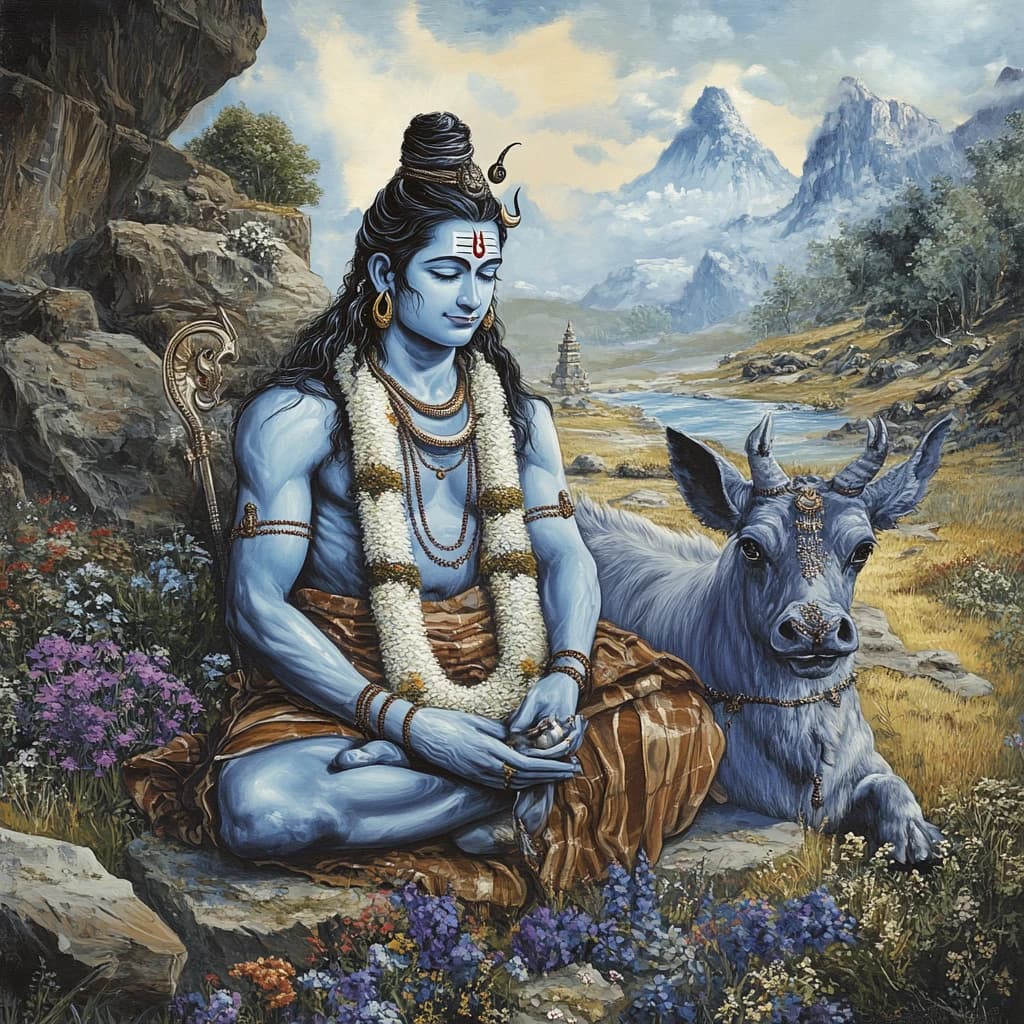
Shiva in meditation with Nandi, the Himalaya rising cold and blue behind them and wildflowers scattered across the foreground rock. The piece works on depth: three distinct planes, each cooler than the last, so the eye travels back into the mountains rather than resting on the figure. A large-feeling work that suits a wall with room to be viewed from across a room.
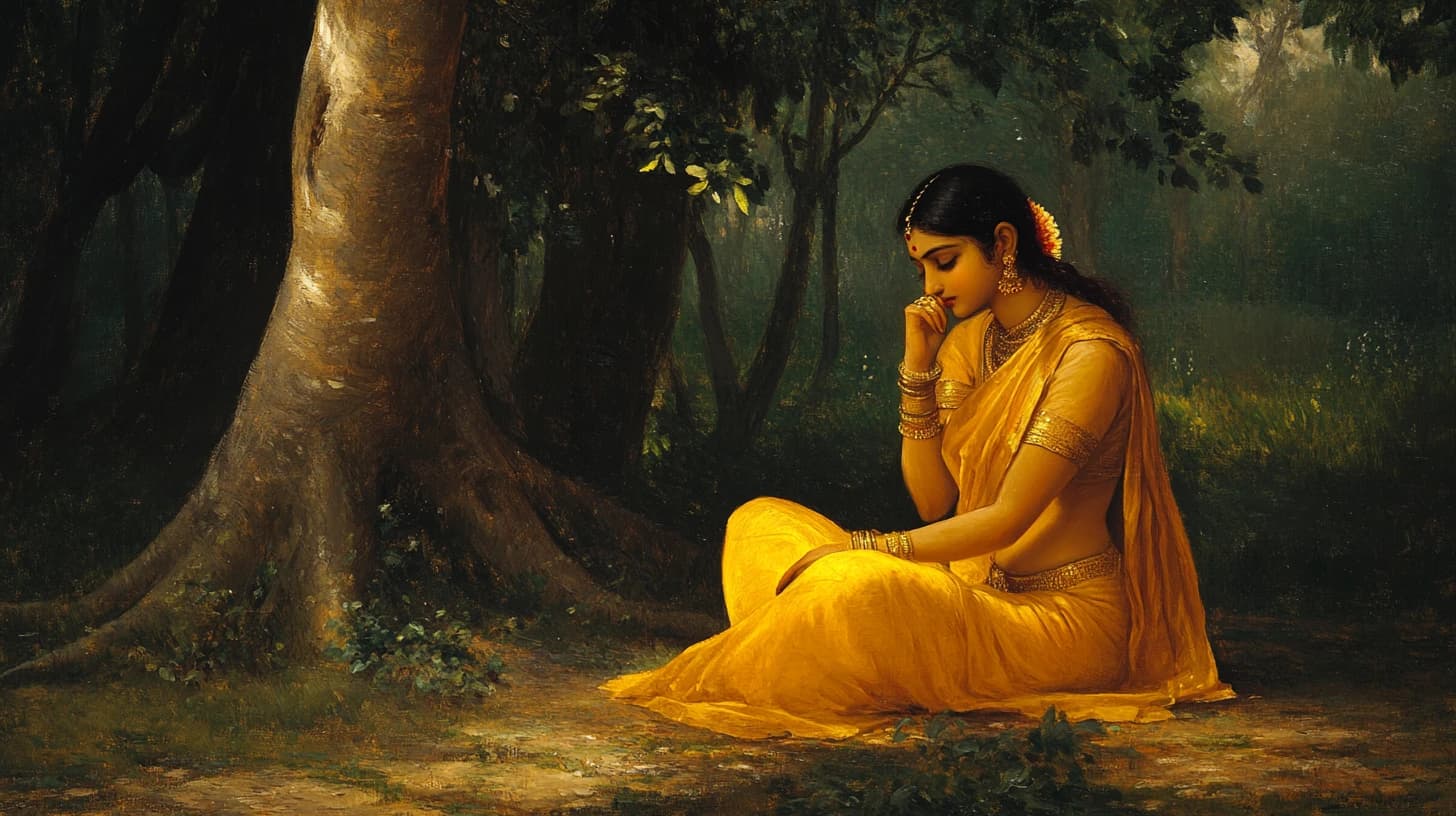
Sita seated alone beneath a broad tree, the yellow of her sari the single warm point in a composition otherwise given over to green shadow. The wide format leaves a great deal of empty space to her left, and that emptiness is the subject as much as the figure is. A contemplative horizontal piece, well suited above a low console or a bed.
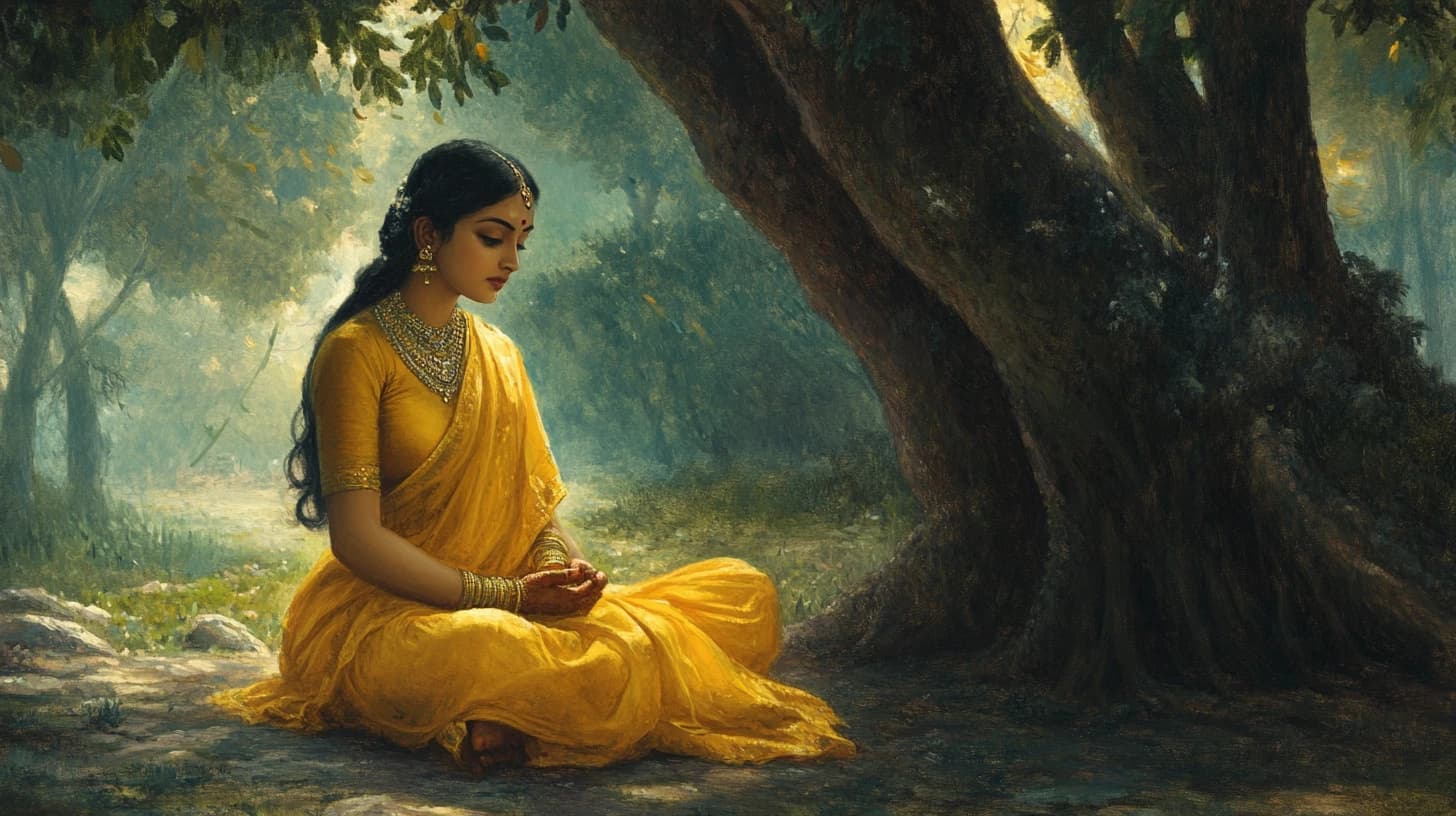
A second reading of the same grove, warmer and closer than the first — the light has moved, the greens have gone golden, and the figure sits nearer the picture plane. Hung as a pair with Waiting Under the Ashoka it reads as a passage of time; hung alone it is simply a very quiet landscape with a figure in it.
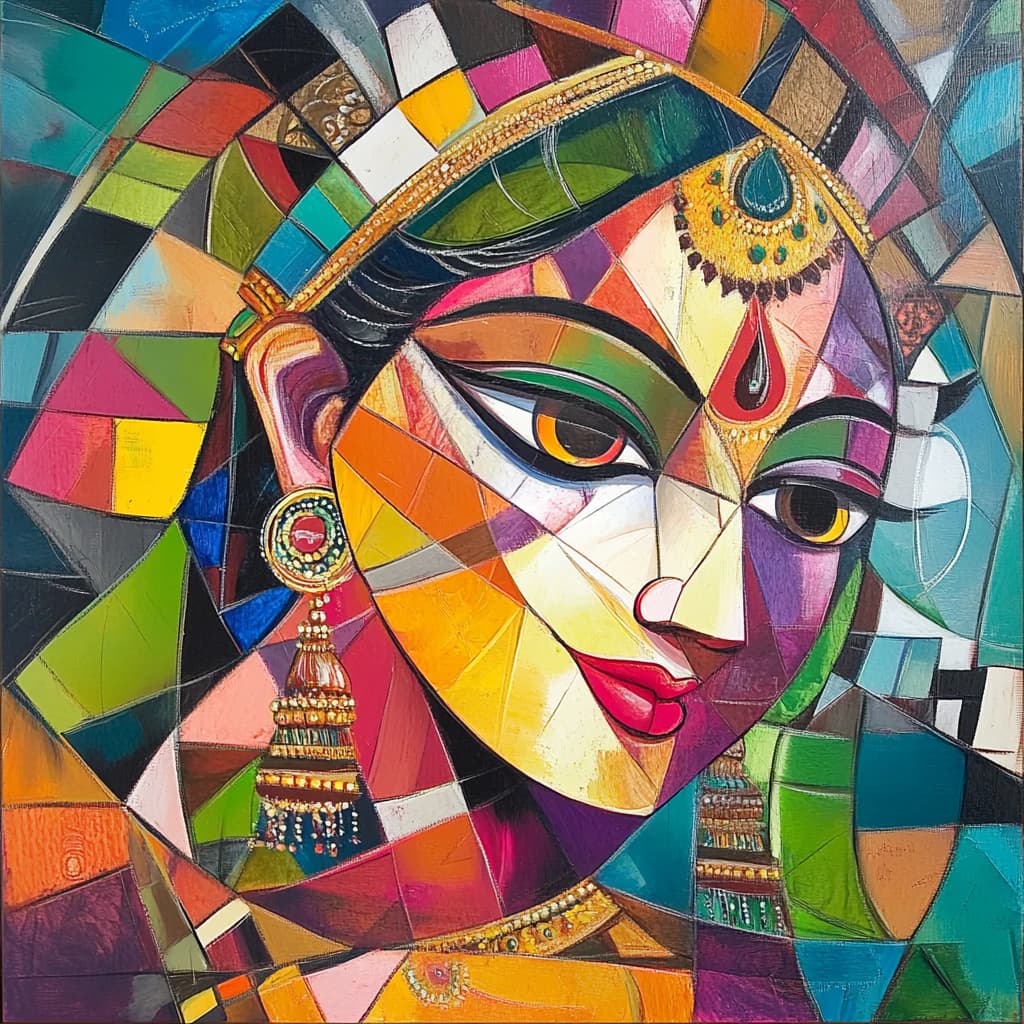
A bridal portrait broken into planes of colour — jewellery, veil and profile reassembled as a mosaic that you read all at once rather than feature by feature. The palette is deliberately unruly: magenta against olive, cobalt against gold. The most extroverted piece in the collection, and the one that will set the tone for whatever room it hangs in.
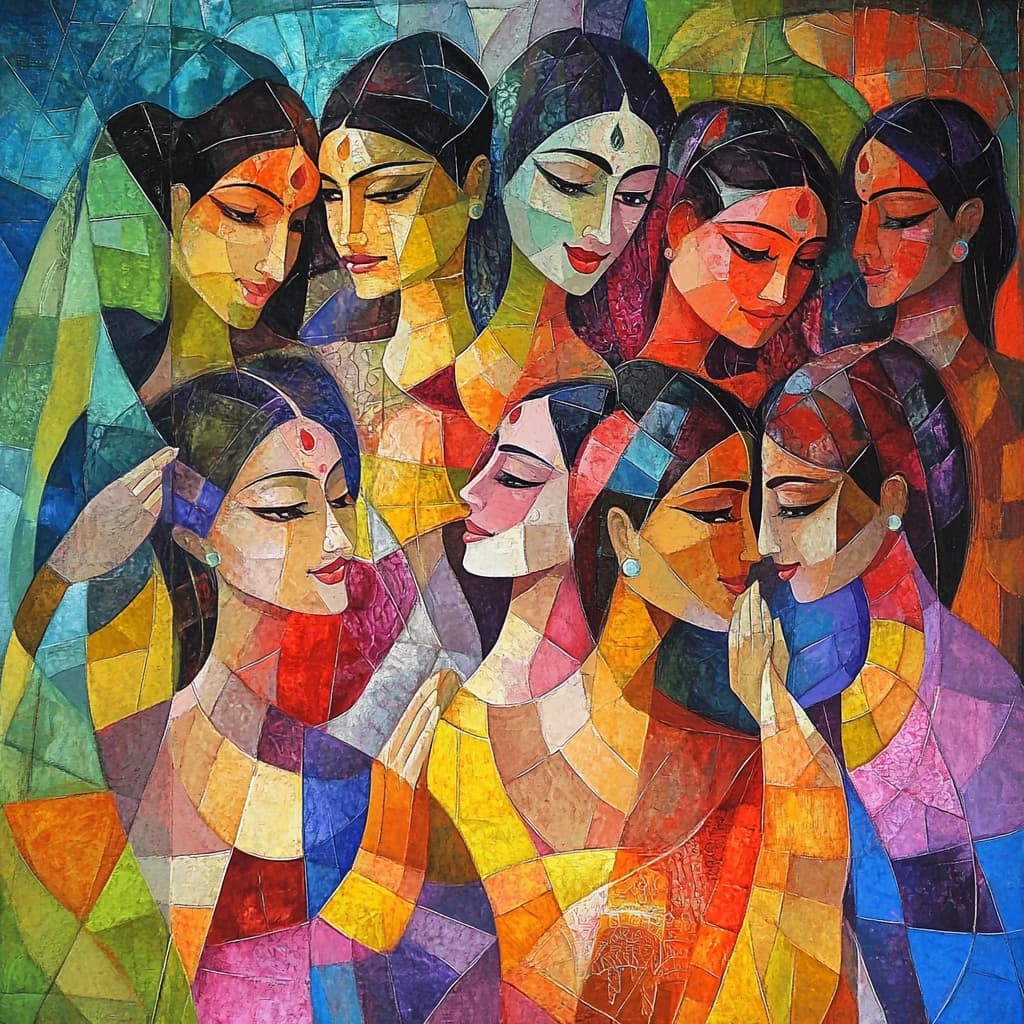
Nine faces pressed into one plane, overlapping the way voices do in a crowded room. Each is resolved just enough to read as an individual before dissolving back into the pattern. The warm palette — rust, saffron, rose — keeps a busy composition from turning cold or clinical. A statement piece for a dining wall or a hospitality space.
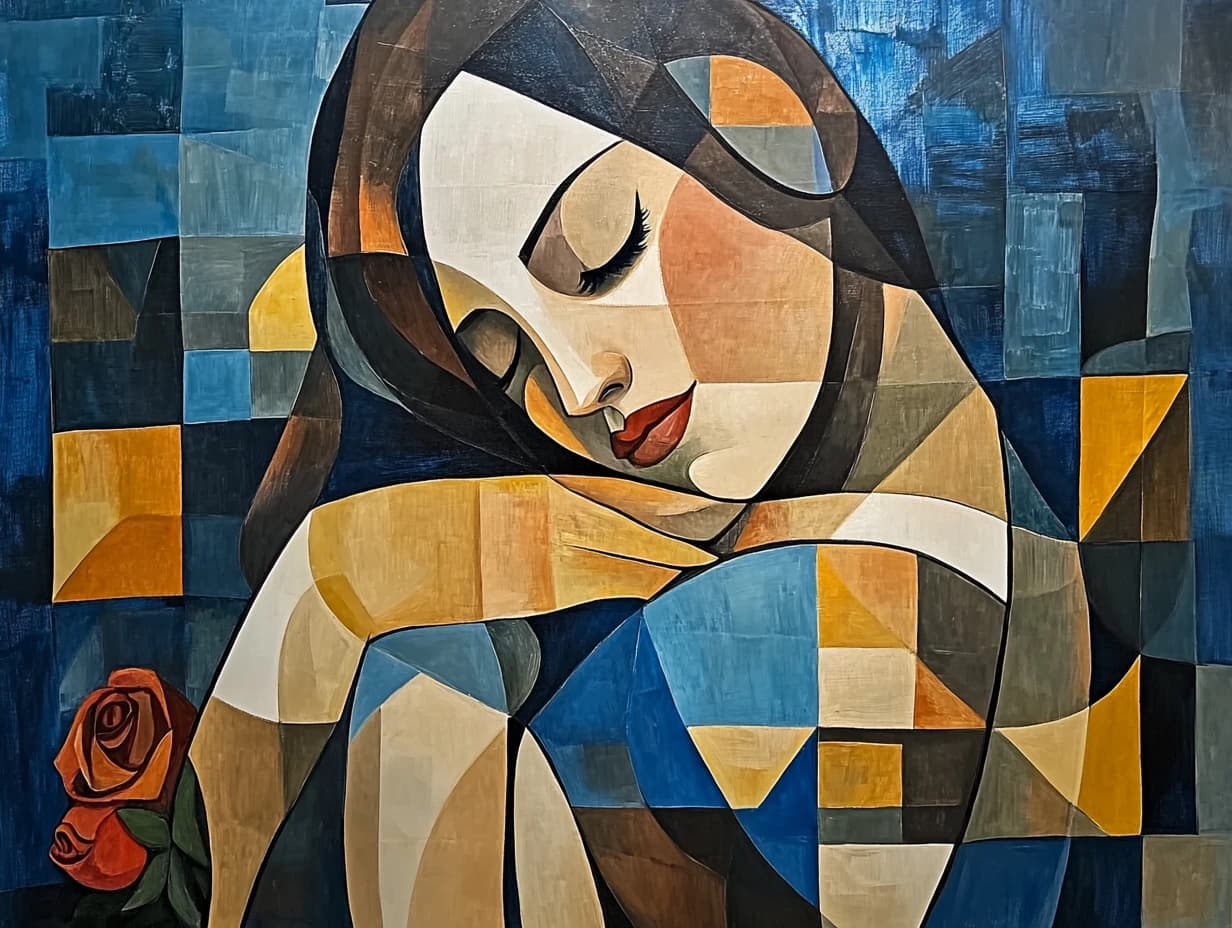
A sleeping figure assembled from slate-blue rectangles, with one deep red rose placed low in the frame as the only warm note. The restraint is the point — nearly the whole canvas sits in a narrow band of blues, so the rose reads as loudly as it does. A calm horizontal piece that works particularly well above a bed.
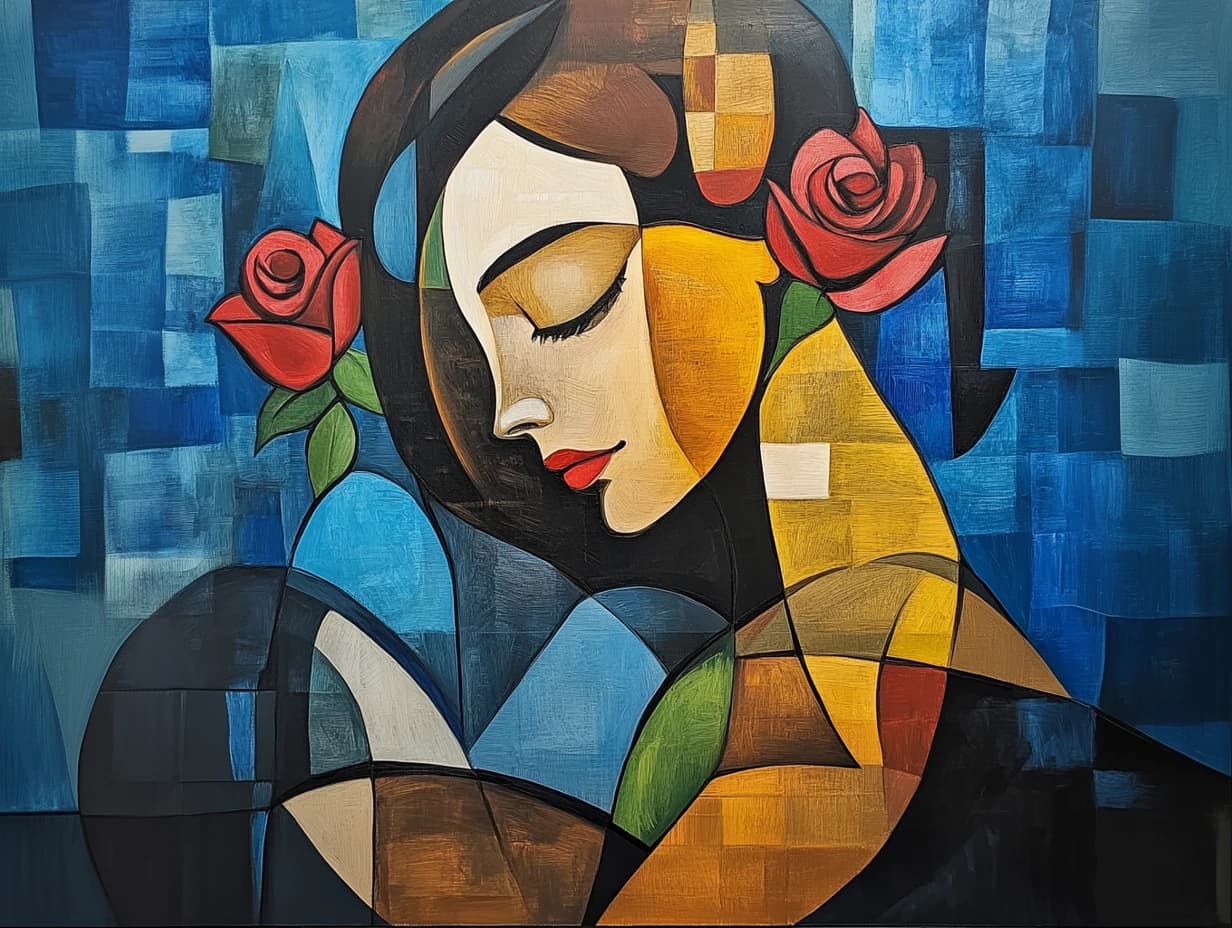
The companion to Rose and Slate: the same blue architecture, the same downturned profile, but two roses now instead of one and the geometry opened up around the shoulder. Bought together the pair reads as a diptych; bought alone this is the warmer and more forgiving of the two.
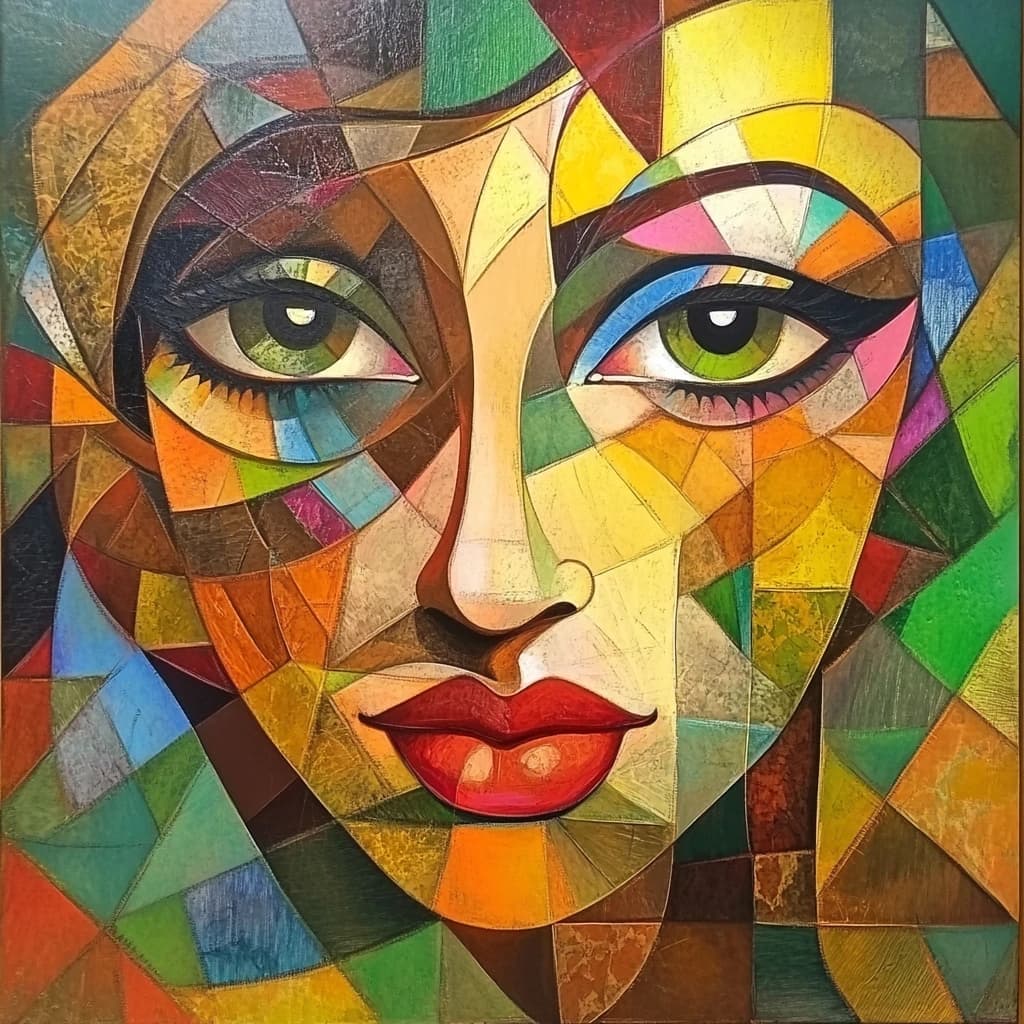
A face brought right up to the picture plane and shattered into gold, olive and turquoise facets, with the eyes left almost intact so that the gaze survives the abstraction. Close-cropped and confrontational in the best sense. Give it a wall of its own and enough distance to resolve.
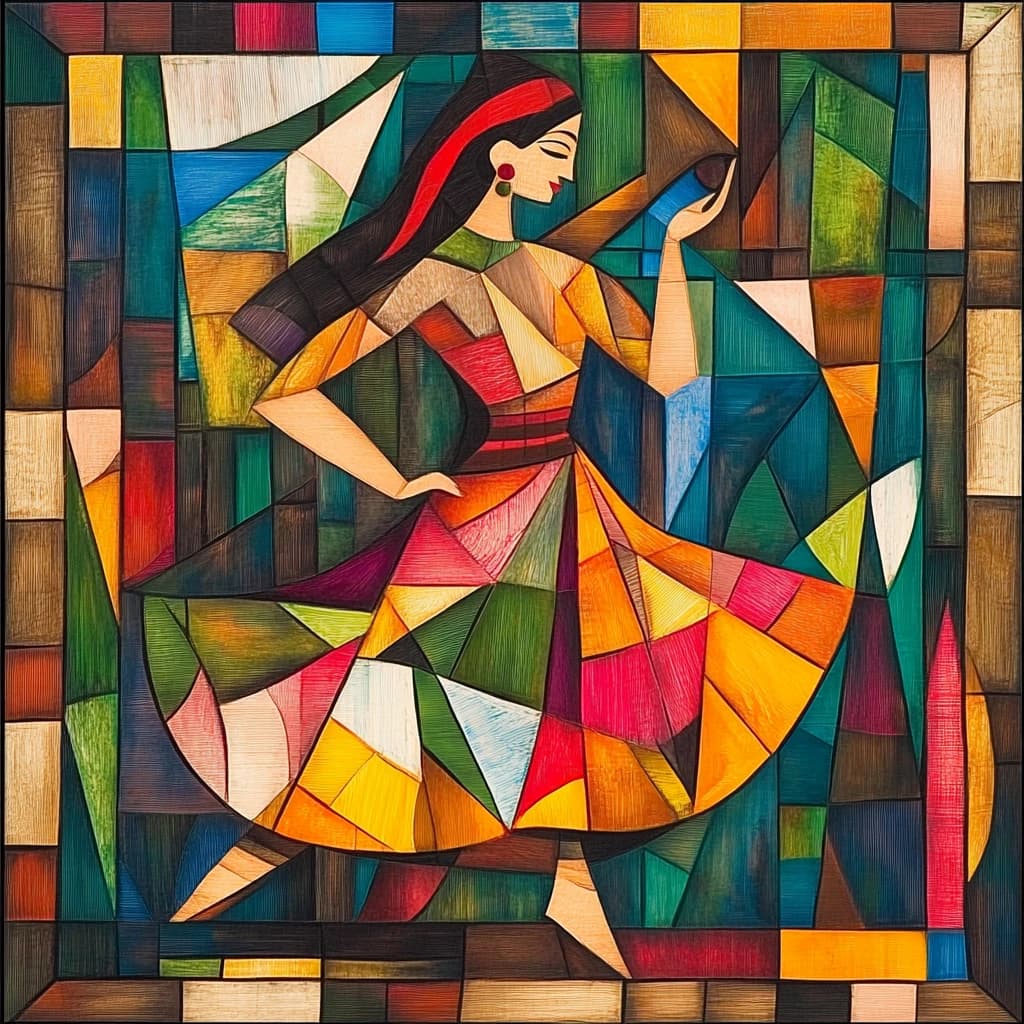
A dancer mid-turn, her skirt fanning into the same tiled geometry as the ground behind her, so figure and background are made of one material. The red carries the movement; the surrounding blocks of ochre and teal hold it still. Energetic without being loud — a good fit for a stairwell or any wall seen in passing.
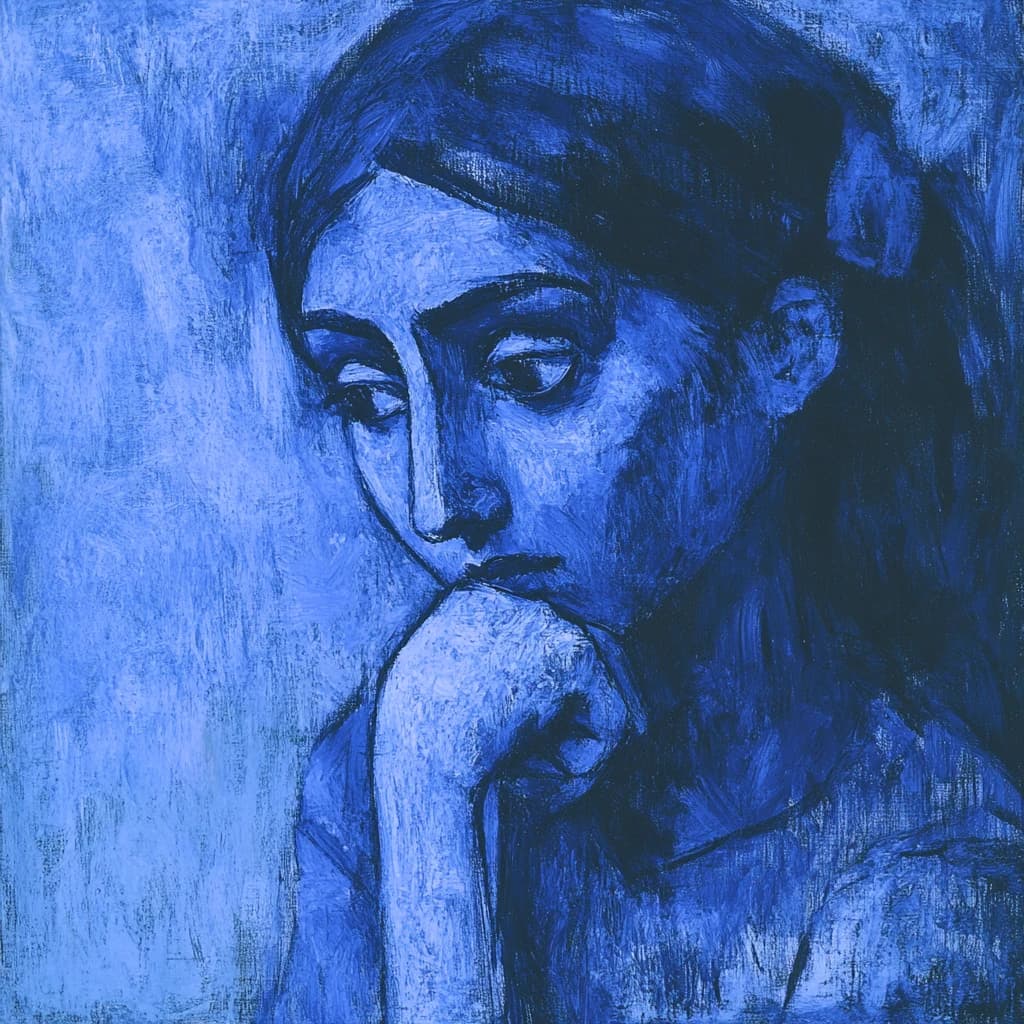
A study in the manner of Picasso's blue period: a woman resting her head on one hand, drawn almost entirely in tone rather than line. The whole canvas sits within a single colour, which throws all the weight onto the modelling of the face and hand. An honest exercise in restraint, and a quiet piece for a reading corner.
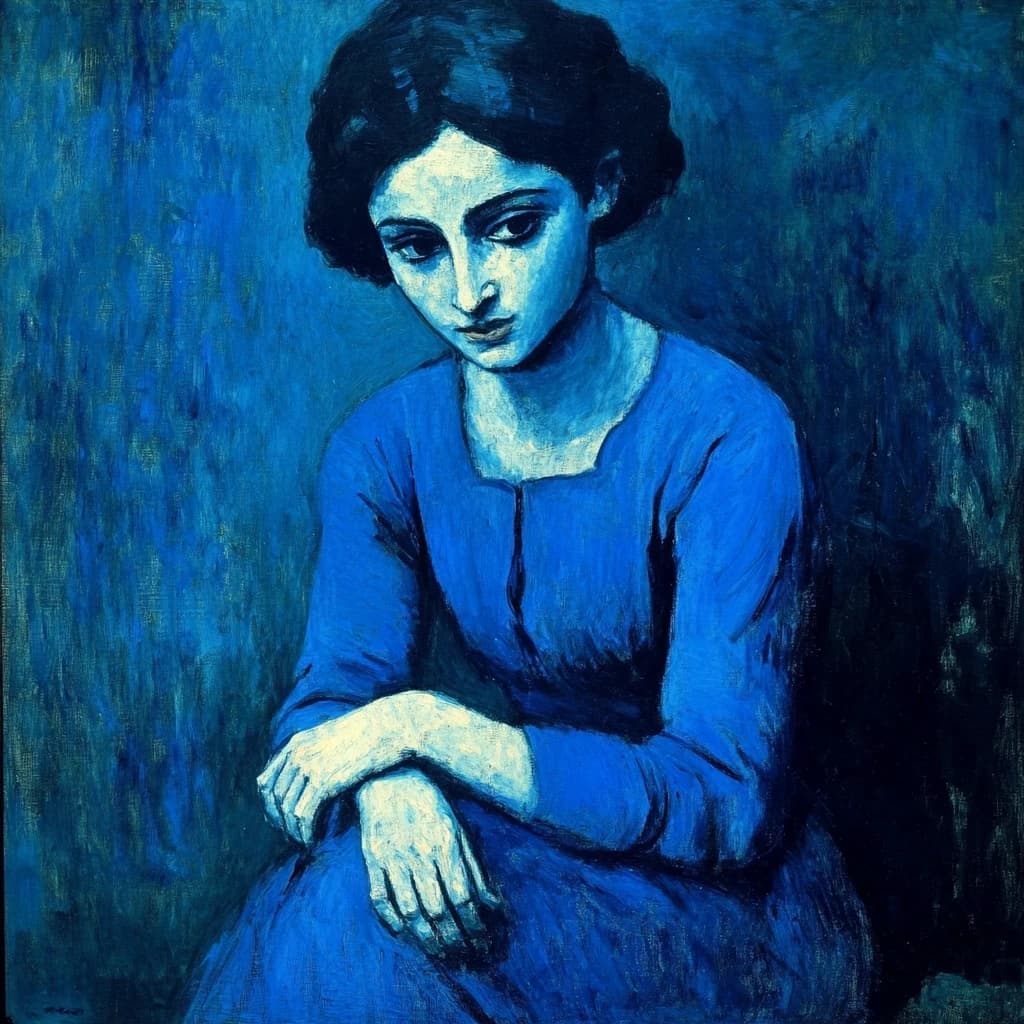
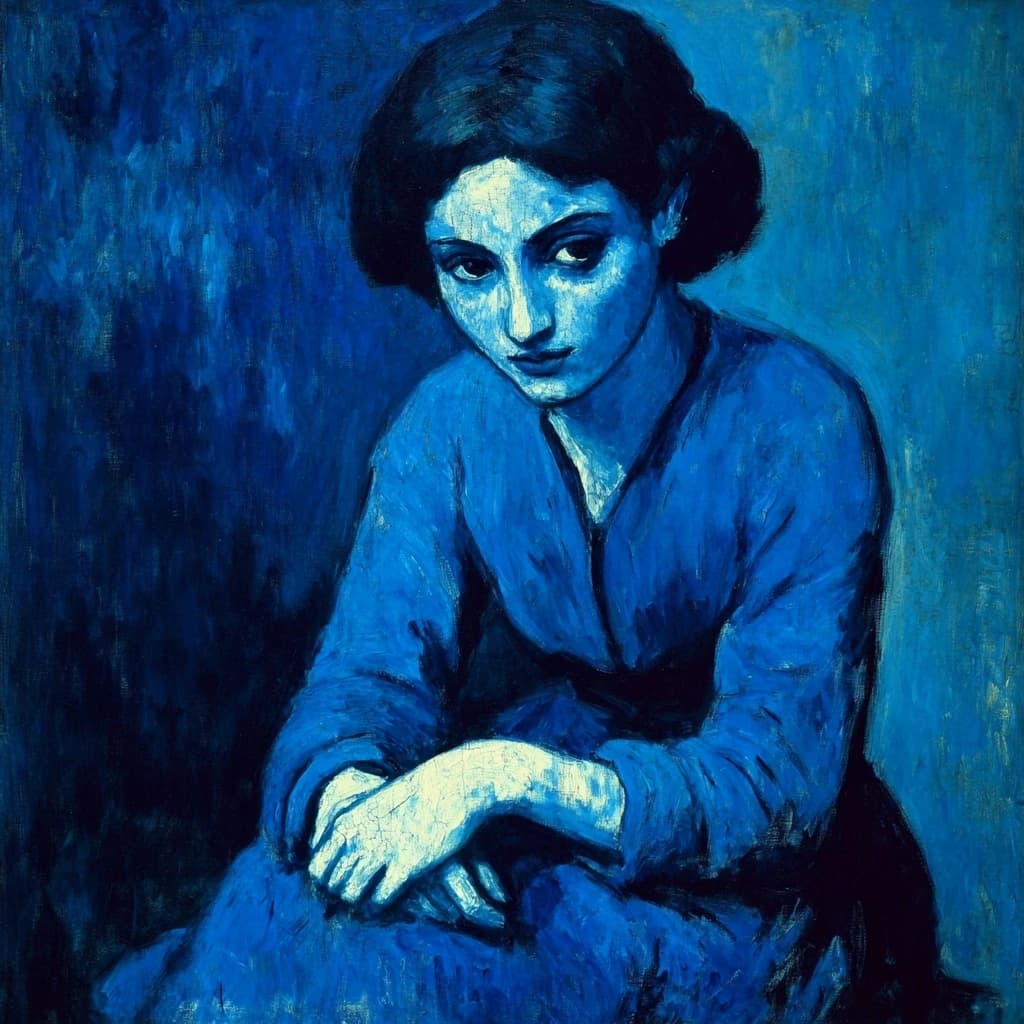
A seated woman with hands folded, worked in the same narrow blue register but with more resolved modelling than the first study — the light on the face and knuckles is doing real work here. The background stays deliberately unfinished, which keeps the attention on the figure. Sold as an individual study, not as part of a set.
The third and most loosely handled of the blue studies — the same seated pose, but the brushwork left open and the edges allowed to break down into the ground. Where the second study resolves, this one stays provisional, and some collectors prefer it for exactly that reason.
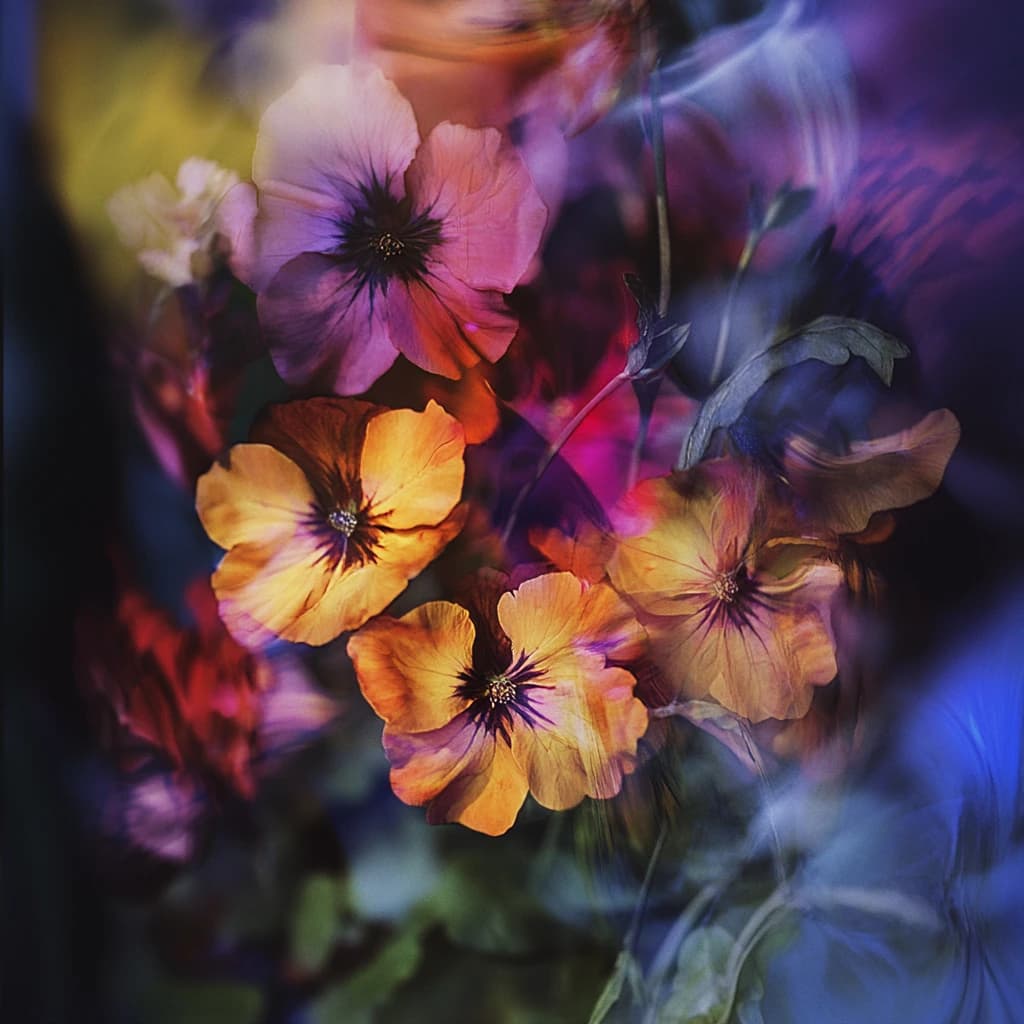
Yellow and violet blossoms lit as though from within, floating against a ground dark enough to read as night. The light is the subject rather than the flowers. Because the background is so deep, it holds its own on a dark or richly painted wall where a paler floral would disappear.
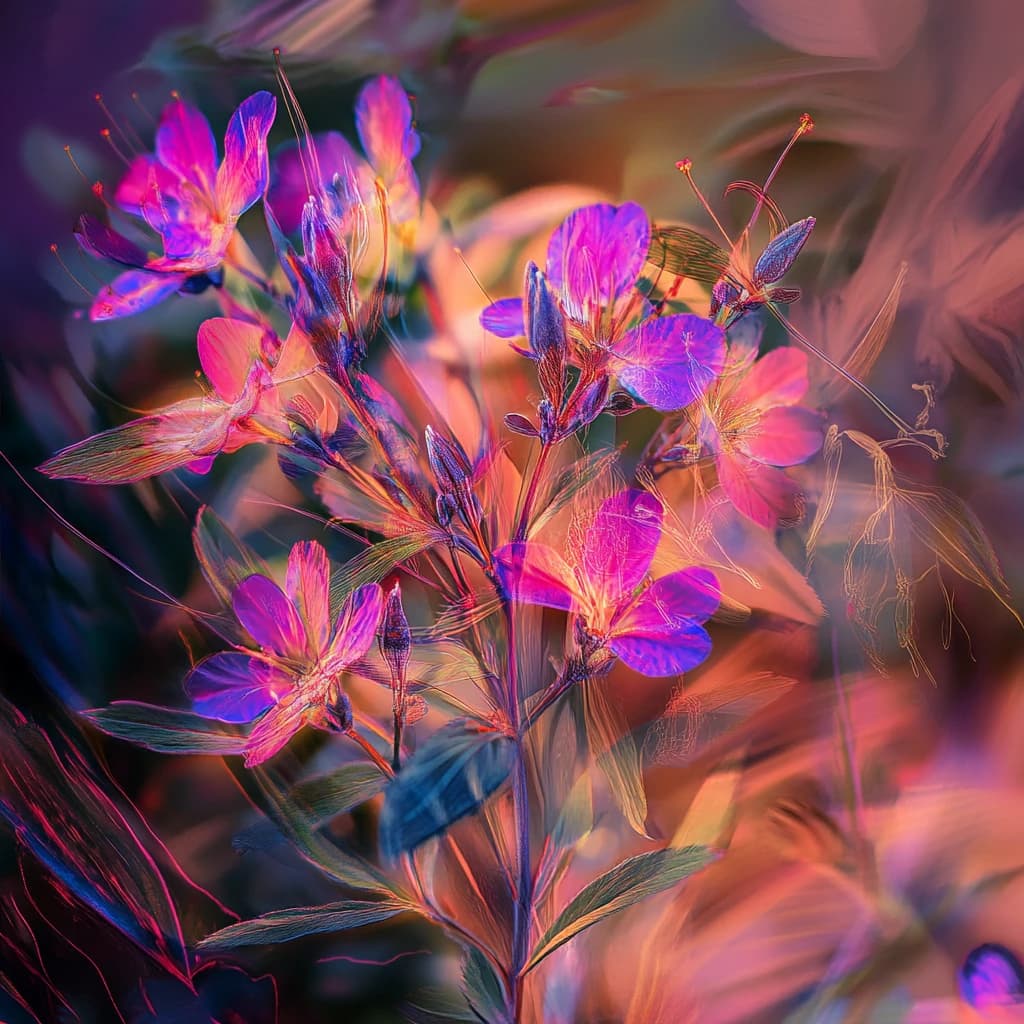
Magenta wildflowers shot through with streaks of backlight, painted with enough motion blur that the whole thing hums. Closer to a photograph of movement than a botanical study. A good choice for a hallway or a bedroom wall that needs colour without needing a focal point.
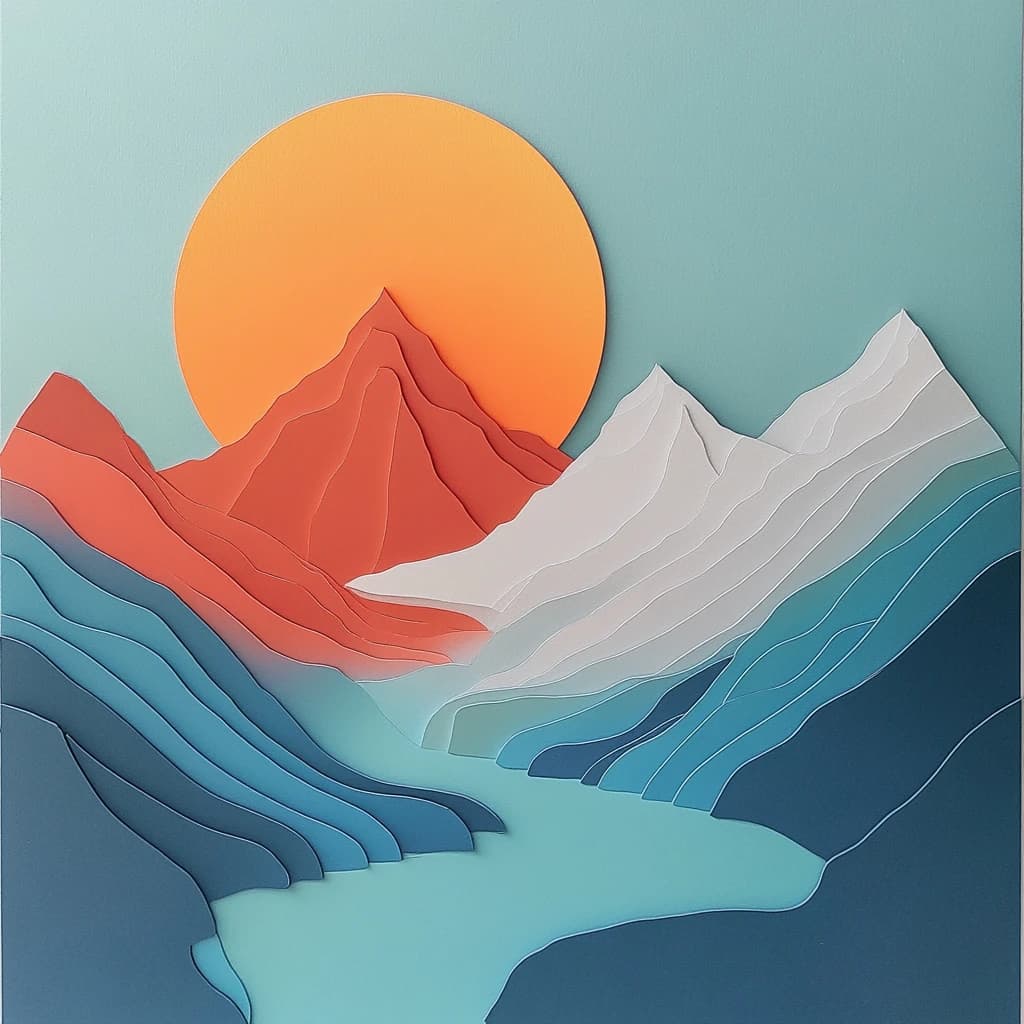
Mountains, river and sun reduced to flat cut-paper shapes in coral, cream and teal — no shading anywhere, just layered silhouettes. The most graphic piece in the catalog and the easiest to place: it will sit happily in a child's room, a home office, or a café without competing with anything.
A tropical shoreline at the moment the sun has gone but the sky has not caught up — palms in silhouette, a thin crescent moon, and the last orange band sitting on the water. Warm and cool in almost equal measure, which is what stops it from tipping into postcard territory.
The same coast an hour later, given over almost entirely to violet — cloud, water and sand all pulled toward the same register, with the white of the breaking surf as the only relief. Hung beside Crescent Over the Cove it extends the evening; hung alone it is a study in how far one colour can carry a landscape.
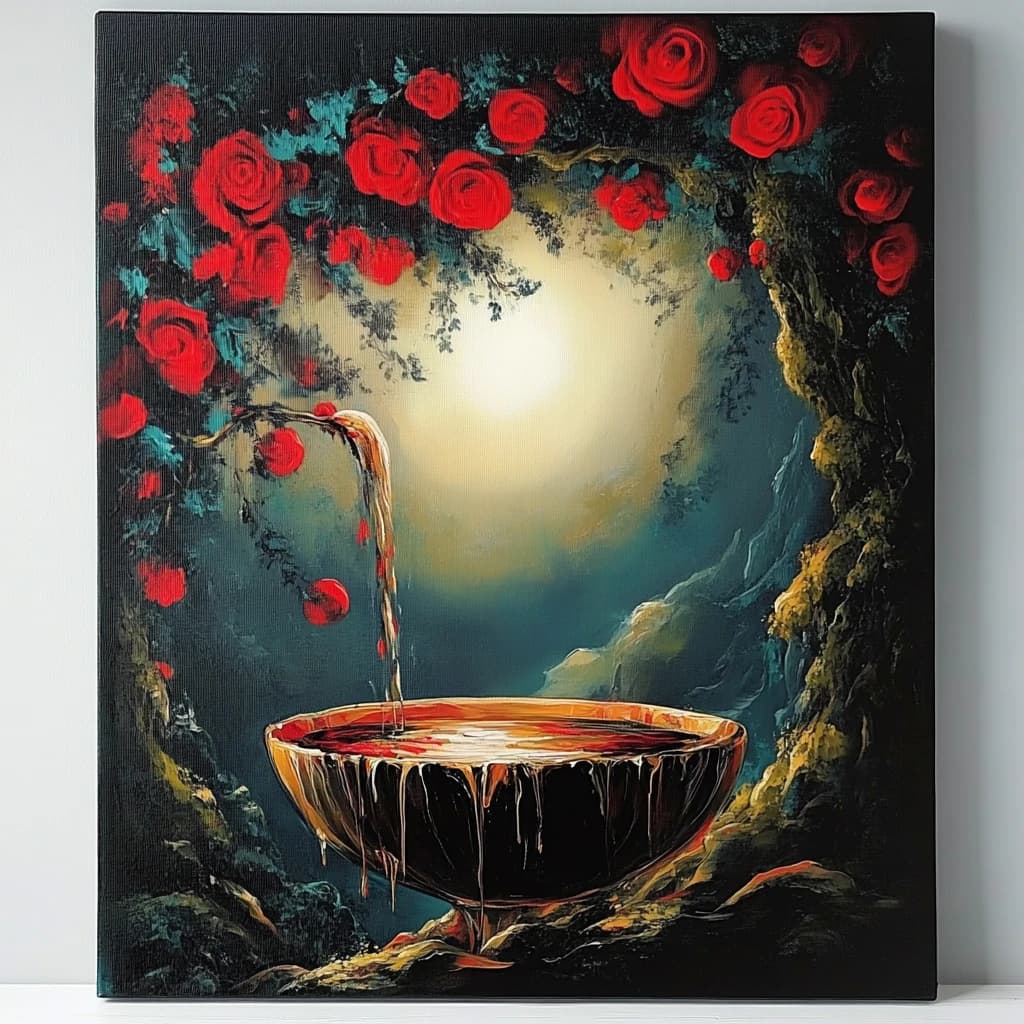
A shallow bowl catching light at the centre of a dense wreath of red roses and dark foliage, painted with heavy impasto so the petals stand off the surface. Nearly baroque in its density. Needs a wall with some space around it and, ideally, light from the side to rake across the texture.
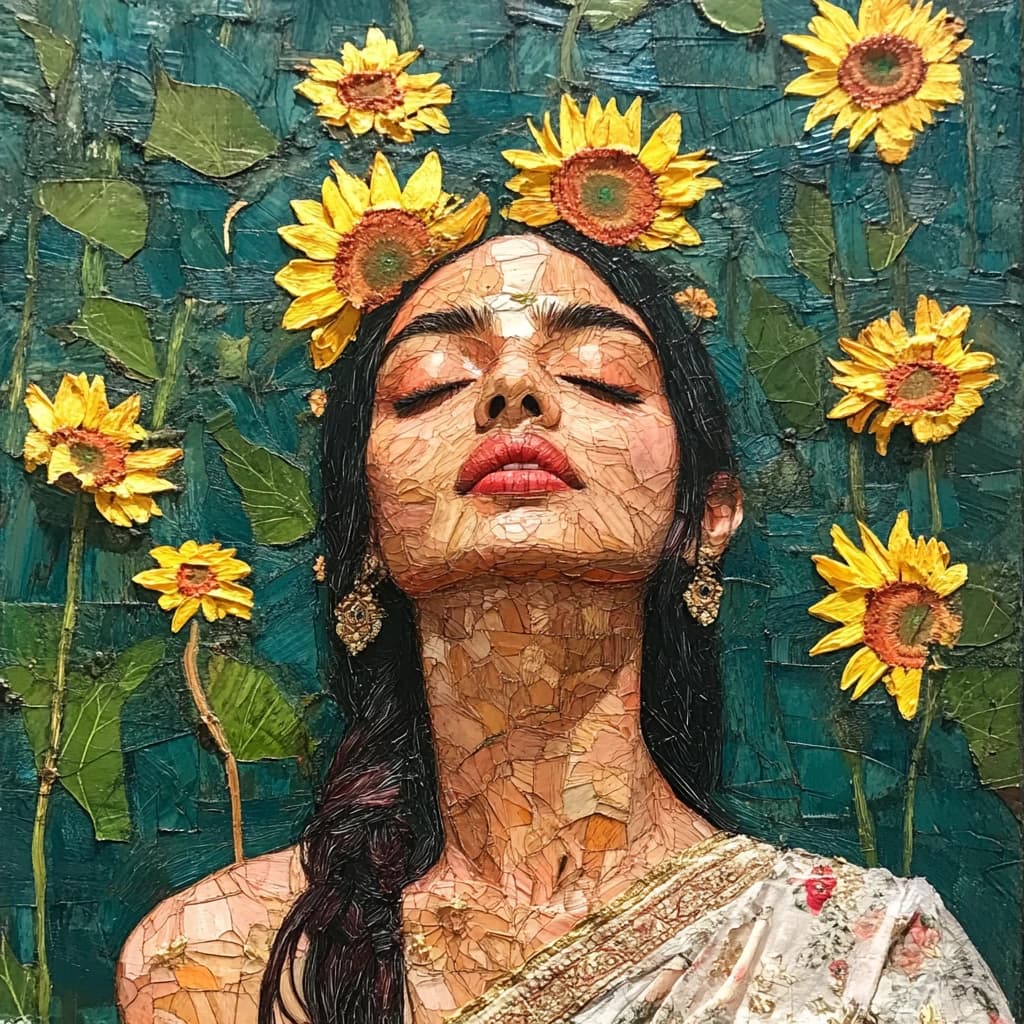
A woman with her eyes closed and her head tipped back, ringed by sunflowers worked in thick palette-knife strokes. The paint is laid on heavily enough that the flowers read as physical objects on the canvas rather than images of flowers. The most tactile piece in the collection — worth seeing in raking light.
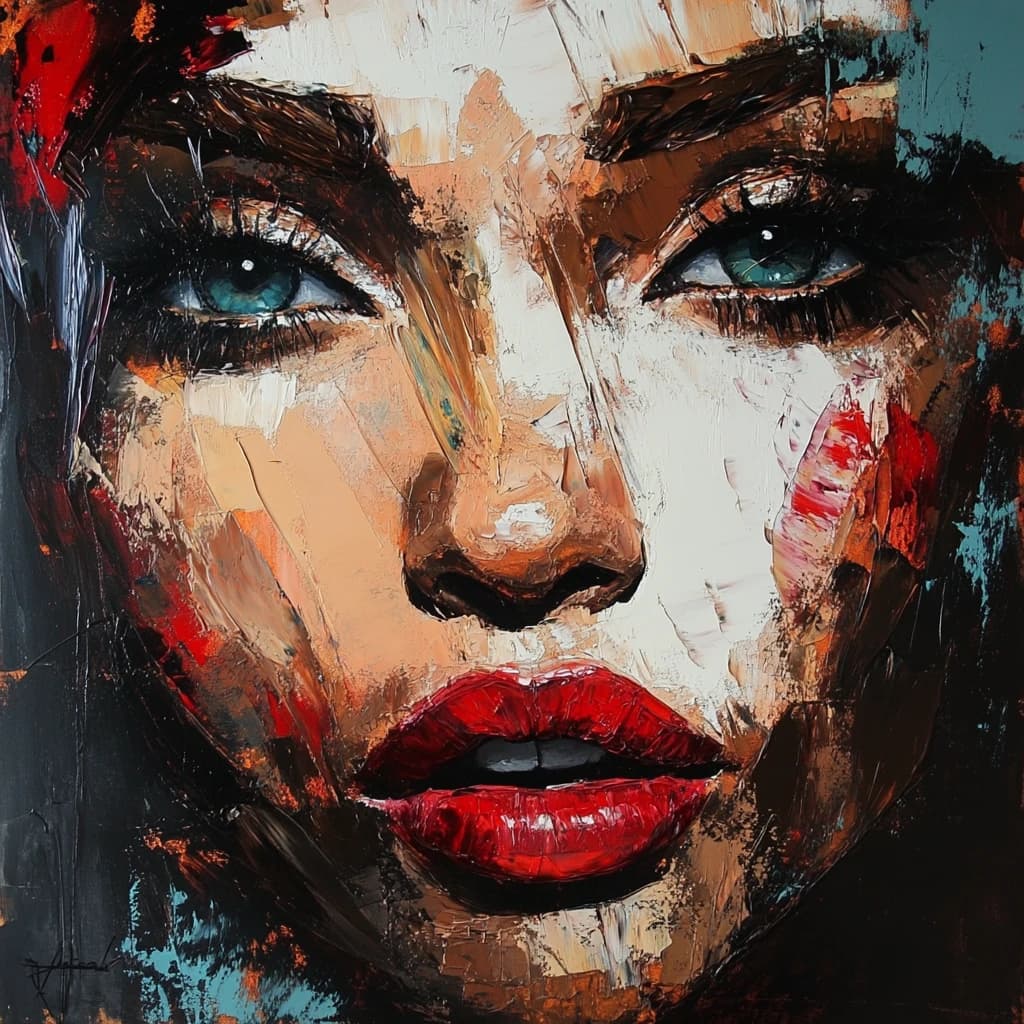
A face built from broad palette-knife strokes of white, black and a single slash of red across the cheek. Almost nothing is described literally — the features assemble themselves at viewing distance and fall apart again up close. Confident, graphic, and best given a plain wall.
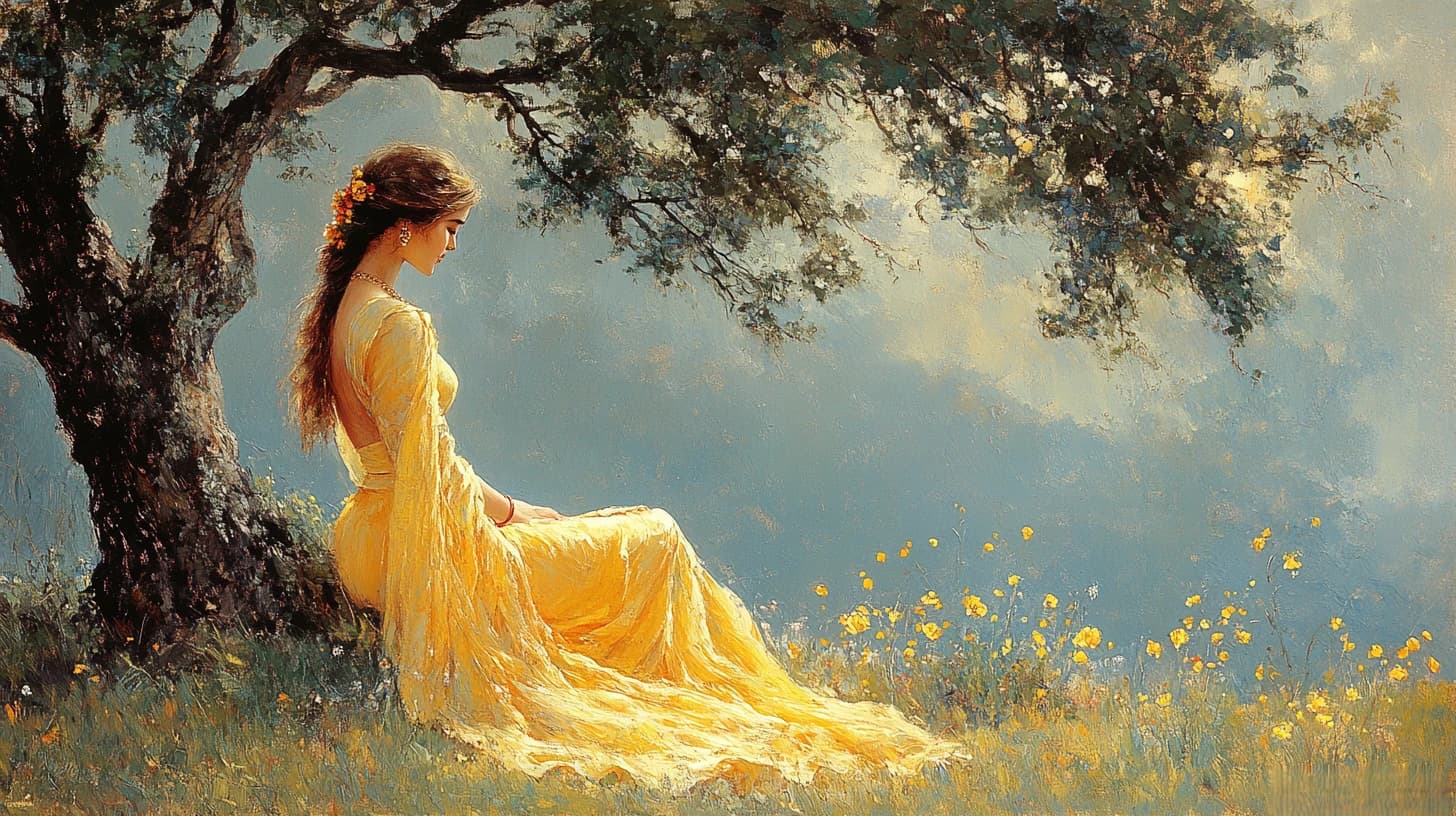
A woman in a pale yellow dress seated in long grass, the whole scene dissolved into soft impressionist light with a single tree anchoring the left of the frame. The wide format and low contrast make it unusually restful. Suits a bedroom, or a long horizontal wall where a busier piece would feel like too much.
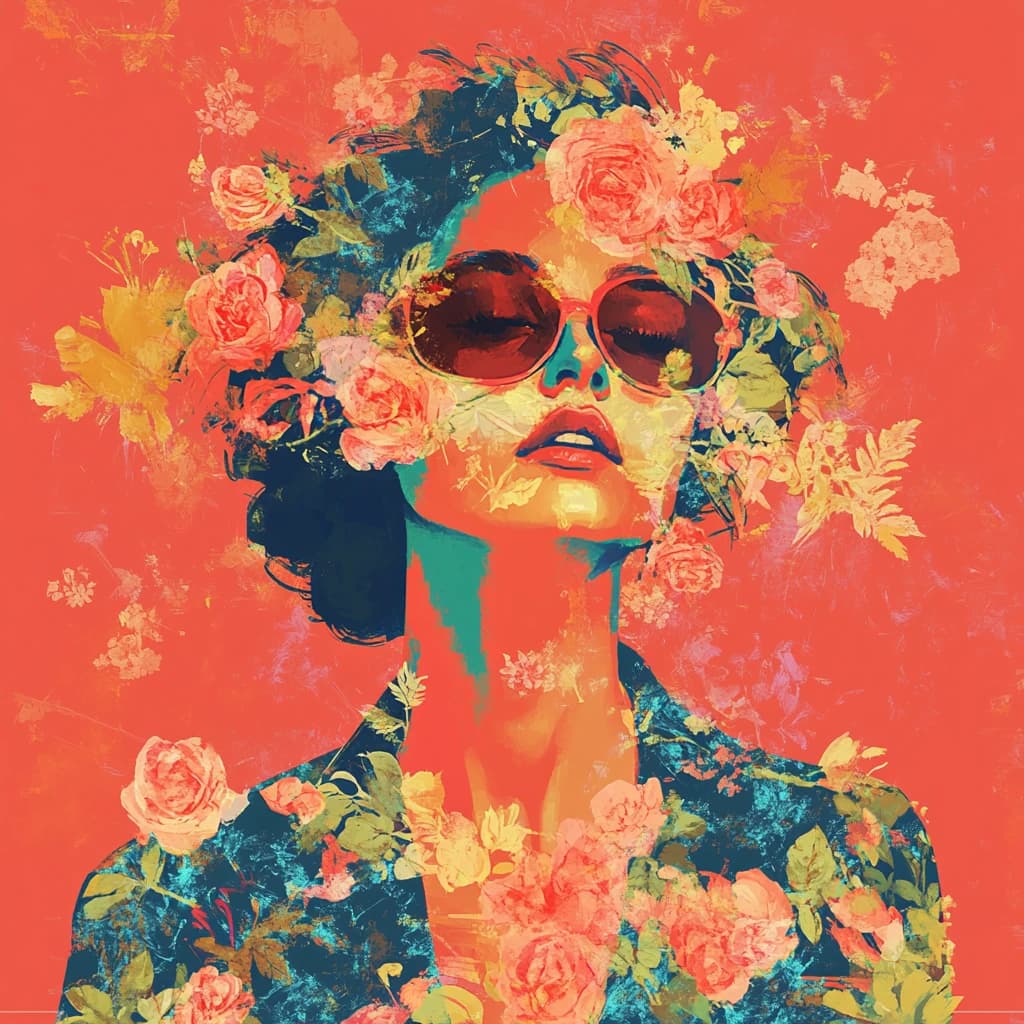
A collage-style portrait — sunglasses, roses and printed fabric layered flat against a coral ground with no attempt at depth. The most graphic and most modern piece here, closer to editorial illustration than to painting. Works well in a café, a studio, or any room that can take a high-chroma flat colour.
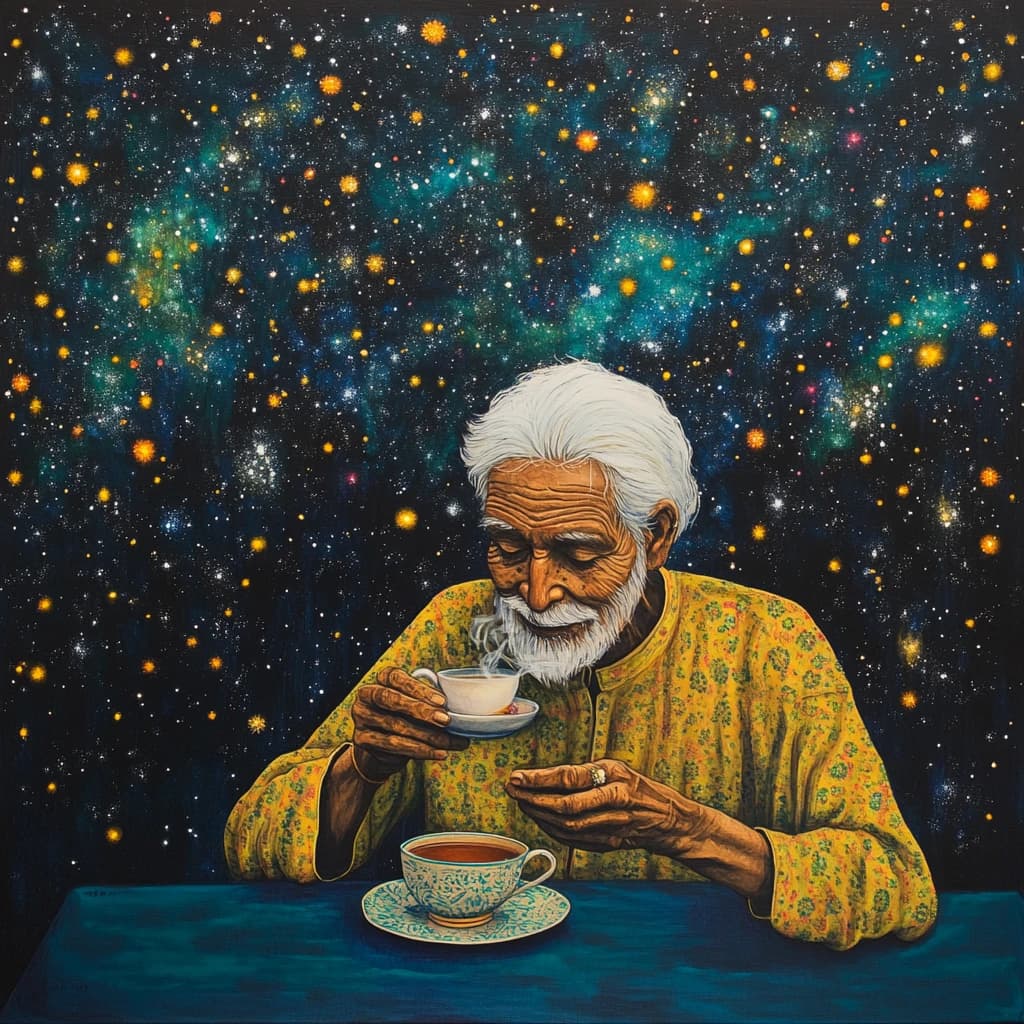
An elderly man bent over a cup of tea, and behind him — with no explanation offered — the whole of a star field. The domestic and the cosmic put on the same plane without comment. The idea carries the piece, and it tends to be the one people ask about. Suits a dining room or a café wall where it will be looked at for a while.
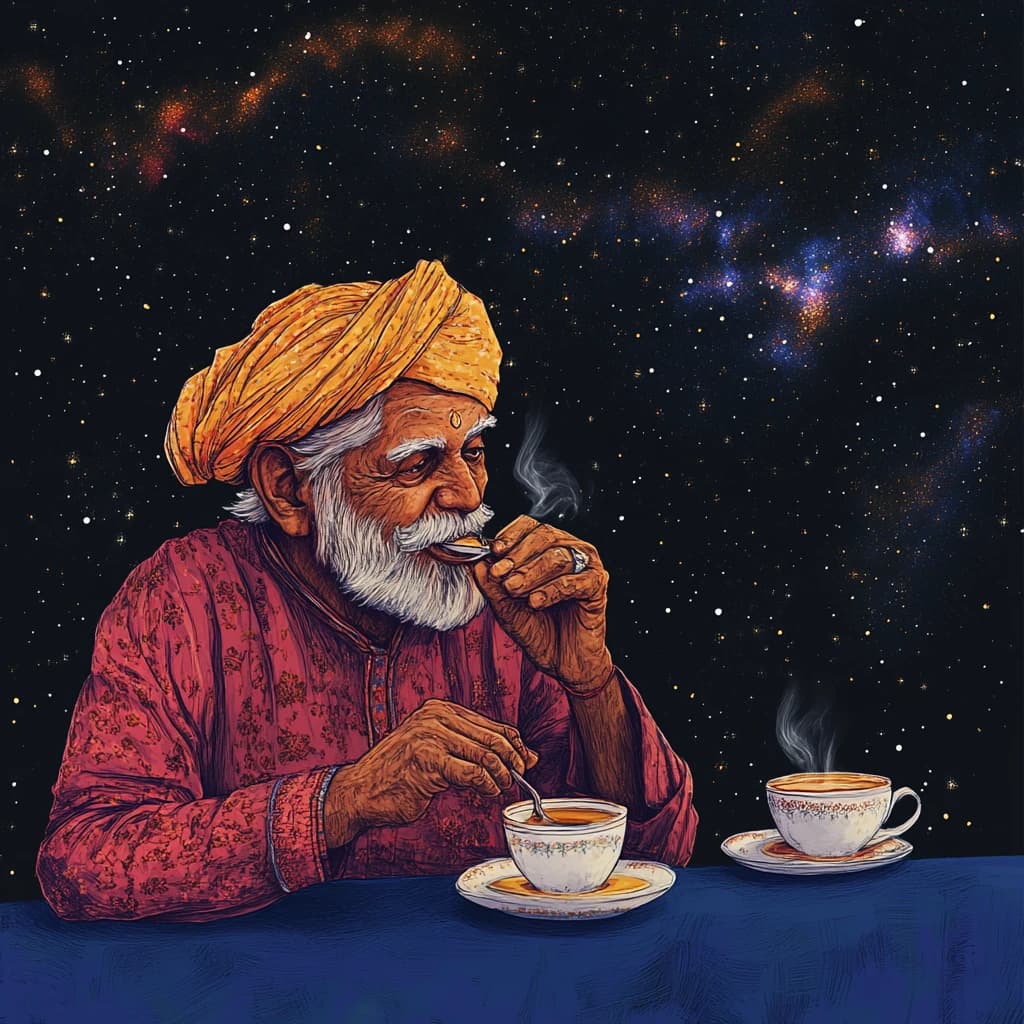
The companion to Chai Under the Stars, and the warmer of the two: a man in a saffron turban with two cups set out on the table in front of him, one of them plainly for someone who has not arrived. The nebula behind him is painted in reds rather than blues. The second cup is the whole story.